
Science Corner 81 | Should You Trust a Proprietary Blend?

In 2019, researchers published an analysis in the journal Nutrients that reviewed the labels of 100 top-selling pre-workout products and compared each ingredient to the research behind it. Fifty-eight of the 100 products used at least one proprietary blend. Across the full sample, ~44% of all listed ingredients had no listed dose. Beta-alanine appeared in 87 percent of the products, at an average of 2.0 grams per serving. The minimal dose shown to be effective is about 4 grams per day, and only one product in the entire sample reached it.
You can read the name of what you're taking. In nearly half the ingredient lines across those 100 top sellers, you couldn't read how much of it you were getting.
That's the deal a proprietary blend makes with you. A label names every ingredient inside it, lists them in order of how much of each there is, states the total weight of the blend, and stops one line short of the actual number that would let you check its work.
Sometimes that missing number wouldn't change anything. A finished formula occasionally gets tested as a whole, at the exact ratio on the label, with a real trial behind it. However, the missing number may also be hiding a blend built mostly of whatever's cheapest, with just enough of the ingredient the product is named for to earn its spot on the front of the box.
What the Law Actually Requires

Under 21 CFR 101.36, a proprietary blend has to do three things: name every ingredient inside it, list those ingredients in descending order by weight, and state the total weight of the blend per serving. It does not have to say how much of any single ingredient is in there, and that line is left blank on purpose.
The compromise is built into the Dietary Supplement Health and Education Act of 1994, which gives supplement makers room to protect a formula the same way a restaurant protects a recipe. Coca-Cola doesn't publish its syrup ratio. A supplement company isn't required to publish its blend ratio either.
The rule does still provide you something useful. Descending order by weight means the first ingredient listed is the heaviest, and the last is the lightest. Combine that with the total blend weight, and you can start ruling things out before you've seen a single milligram attached to a single ingredient.
Here is an Example (This Product is Not Real)
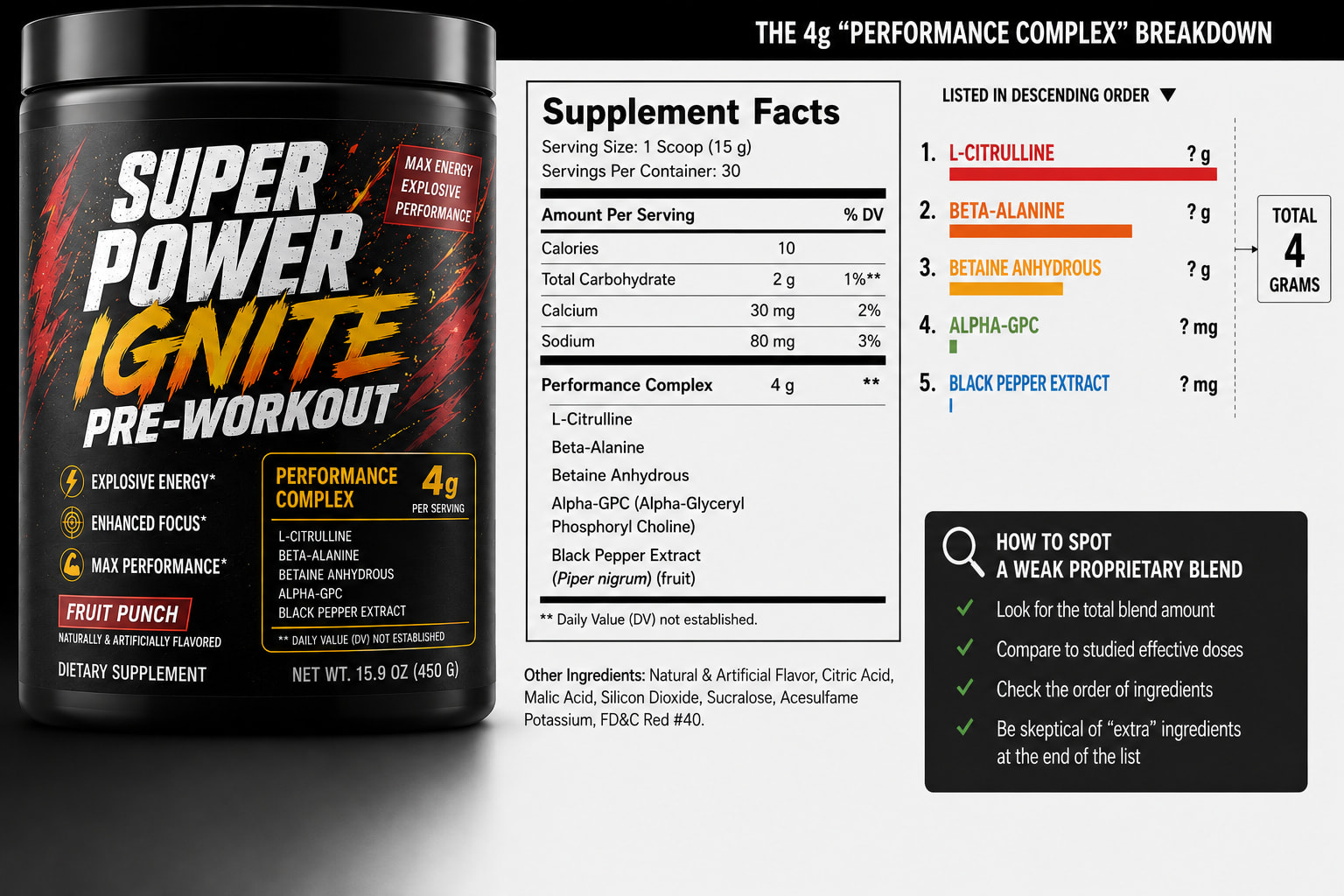
Picture a fictional product called Super Power Ignite Pre-Workout. The label lists a "Performance Complex" of 4 grams, with ingredients listed in this order: L-citrulline, beta-alanine, betaine anhydrous, alpha-GPC, and black pepper extract. Descending order means citrulline is the heaviest ingredient in that complex and black pepper extract is the lightest.
The studied dose of citrulline malate for exercise performance runs 6 to 8 grams. Even if the entire 4-gram complex were nothing but citrulline, it would land 33 to 50 percent short of that range. But citrulline actually has to share the 4 grams with four other ingredients, so the real amount is smaller still. By the time the list reaches alpha-GPC and black pepper extract, there may be single-digit milligrams left to split between them, even though both names can sit in bold letters on the front of the box.
A 4-gram blend can't clear an 8-gram clinical dose. The order on the label just tells you who loses first.
Pre-workout makes this math easy to see because the doses involved are large enough to measure in grams. The same rule governs a greens powder's "Superfood Blend" and a multivitamin's herbal complex: name the ingredients, order them by weight, disclose the total. The category and overall clinical doses may be different, but the concept is the same.
Fairy Dusting Has a Name for a Reason
There's a specific term for what can happen to the last name or two on an ingredient list, and it isn't flattering. Fairy dusting is including an ingredient at an amount too small to do anything measurable, purely so its name can appear on the label. The dose doesn't have to be in any amount that would have any sort of purported benefit. It just has to exist.
Black pepper extract is a good example of why a small number doesn't automatically mean fairy-dusted. Piperine is the compound in black pepper that improves absorption. A label can say the same thing whether it contains that full 20 milligrams or 1. The skill is knowing which ingredients work like piperine, in smaller amounts, and which ones, like citrulline, need grams to do anything.
Signs an ingredient might be fairy-dusted:
It's the last or second-to-last name in a long ingredient list.
The total blend weight is already too small to cover the first-listed ingredient at a studied dose.
The ingredient is featured on the front of the package but never appears with a milligram amount on the label.
The claimed benefit requires a gram-level dose in the research, and the blend is measured in milligrams.
None of that proves an ingredient is useless. It means the label has given you every reason to check before you believe the front of the box.
Two Different Reasons This Happens. Only One Should Bother You
Proprietary blends exist for two different reasons. Unfortunately, the label looks identical either way.
The first reason is important. A company spends years landing on a specific ratio of ingredients, sometimes patents it, and doesn't want a competitor copying the formula by next quarter. A small number of blends are also tested as finished products, with a published trial run on the exact combination on the label. That's a good signal the blend was built to work, not just built to sell.
The second reason is much less savory, and it's the one this piece is specifically about: a company builds a blend that's mostly the cheapest ingredient available, and adds just enough of the ingredient the product is named for to justify the name on the box. The label discloses each ingredient the law requires and still tells you almost nothing true about what's in your hand.
Trade secrets protect a formula. Cost camouflage protects a margin. The label cannot tell you which one you paid for.
A fully disclosed label doesn't solve the problem on its own. Knowing a scoop contains 6 grams of citrulline malate doesn't confirm the raw material came from a reliable supplier or that the bottle in your hand matches the panel. Third-party programs like TESTED by SuppCo, NSF Certified for Sport, and USP Verified confirm a product is free of specific contaminants and that a lab can verify what's inside, not the exact milligram count of every ingredient in a blend, batch after batch. Full disclosure is necessary. It isn't the same as proof.
The One Check That Works on Any Blend
Here is one thing that you can do. Reliably. Every time. And the best part is that it does not require a lab.
Look at the total amount of ingredients in a blend. Then compare that to the first ingredient's clinical range for effectiveness. Does the blend have enough total weight to support even that first key ingredient? Even if it contained nothing else?
If it can't clear that bar, nothing listed behind it clears it either. The same check works on a pre-workout, a greens powder, or the herbal complex hiding at the bottom of a multivitamin panel.
--
Personal note from Jordan
I've said publicly, more than once, that I'm not a fan of proprietary blends, and I stand by that. It doesn't mean every blend is bad. I respect a company that spends real time and money landing on a specific ratio, protects that formula, and then backs it up with a published trial showing the finished product actually works. What I can't respect is a brand that uses the exact same three-line disclosure to hide ingredients it never intended to dose properly in the first place.
That's the real reason I stay skeptical of blends as a category. The number of companies doing this the right way, research first, is… smaller, and the gap between those companies and everyone else pumping out an unverified complex is enormous. Outside of the check earlier in this piece, there's no way to guarantee a blend is working if there's no research behind it.
One more thing worth doing while you're at it: when you find a study, check what it actually measured. A paper can report a real, clinically significant result and still be measuring an outcome that has nothing to do with what you actually care about. That happens more often than people expect. Learn to spot it before you trust the conclusion.
Take your health into your own hands. Ask questions. Bring them to the SuppCo forum. We'll answer, I’ll answer, and so will the community.