
Science Corner 48 | Moringa and the FDA: Multiple Recalls Explained

Over the past month, three moringa-containing supplements have been subject to FDA recalls and outbreak investigations tied to Salmonella contamination including a drug-resistant strain.
In order to protect our community, SuppCo has sent three separate email notifications to users who have the following products in their stacks, and we are working on a warning label that will be available on these product pages soon:
Rosabella Moringa, 60 capsules - 2,618 users
Live It Up Super Greens Powder, 30 servings - 836 users
Why Not Natural Moringa, 120 capsules - 47 users
These recalls are extremely concerning. Before walking through what happened, it is worth grounding ourselves in what moringa is and how it is typically used.
What Is Moringa?
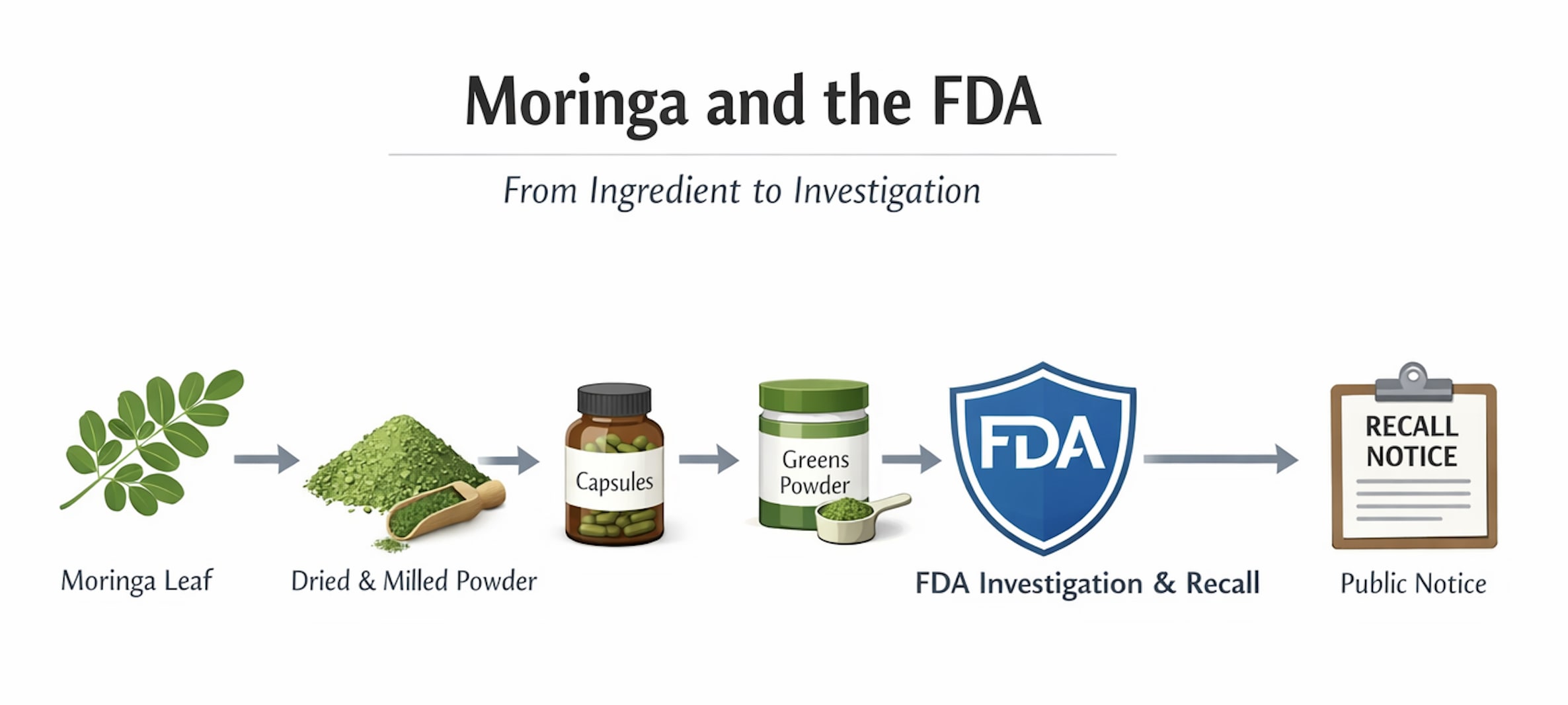
Moringa oleifera is a leafy plant native to parts of Africa and South Asia. In supplements, its leaves are harvested, dried, milled into powder, and then either encapsulated or blended into greens powders.
It is commonly marketed for antioxidant support, immune health, blood sugar balance, and general nutrient density.
From a regulatory standpoint, moringa is treated as a food-derived botanical ingredient. That matters, because microbial safety for dried plant materials follows the same fundamental principles as other agricultural ingredients.
A Brief Timeline of Recent FDA Actions
In late January and mid-February 2026, FDA published multiple actions involving moringa-containing products.
January 28, 2026
Why Not Natural announced a voluntary recall of its Organic Moringa Green Superfood capsules due to potential Salmonella contamination.
January 29, 2026
FDA and CDC announced a multistate outbreak investigation involving Salmonella Typhimurium and Salmonella Newport linked to products containing moringa leaf powder. FDA reported 65 illnesses across 28 states and 14 hospitalizations.
Products identified in that investigation included:
Why Not Natural “Pure Organic Moringa Green Superfood” capsules
Live it Up “Super Greens” powder
FDA indicated that traceback identified a common manufacturer connected to implicated products and that moringa leaf powder was the ingredient associated with the outbreak.
February 13, 2026
FDA and CDC announced a second outbreak investigation involving Salmonella Newport linked to Rosabella-brand moringa capsules distributed by Ambrosia Brands.
Seven illnesses and three hospitalizations were reported. FDA stated that the outbreak strain was extensively drug-resistant.
On the same day, Ambrosia Brands announced a recall of certain lots of Rosabella Moringa Capsules.
What Is Important Here
There are several factual points worth emphasizing.
The affected products were not limited to one form factor. Both encapsulated moringa supplements and powdered greens formulations were identified in the January outbreak investigation.
FDA publicly noted that at least one outbreak involved products connected to a common manufacturer.
One of the investigations involved an extensively drug-resistant strain of Salmonella, a detail highlighted by CDC because it may affect clinical treatment decisions.
What has not been publicly determined is where in the supply chain contamination occurred. FDA has stated that traceback and laboratory analysis remain ongoing.
How Salmonella Is Normally Controlled in Supplements
Dietary supplements are regulated under current Good Manufacturing Practices. For botanical ingredients such as moringa, microbial safety generally involves layered controls:
Raw ingredient specifications, including limits for pathogens such as Salmonella
Batch testing of finished products for specified microorganisms
Sanitation and environmental monitoring programs within manufacturing facilities
Testing methods for Salmonella typically involve enrichment procedures designed to detect low levels of contamination.
These systems are designed to prevent contaminated products from reaching consumers. When contamination is identified or illnesses are reported, additional public health processes are triggered.
How Recalls and Outbreak Investigations Work
When illness clusters are detected, state health departments notify federal partners. CDC coordinates epidemiologic investigation to identify common exposures. FDA conducts traceback analysis to identify product and supply chain connections.
If a product is identified as potentially contaminated, companies remove affected lots from the market. In most cases, recalls are voluntary. A company may initiate removal independently or following FDA recommendations. FDA also has authority to mandate recalls in limited circumstances involving serious health risks.
Separately, FDA assigns recall classifications based on the level of health hazard. Classification reflects risk severity, not who initiated the recall.
In the recent moringa cases, the recall notices were issued by the companies involved, and FDA published outbreak investigation updates as part of its public health response.
What This Means for Consumers
Recalls and outbreak investigations are part of the food and supplement safety infrastructure. When contamination is detected, products are removed and investigations continue.
Consumers who have purchased moringa products can review FDA recall notices for specific lot numbers and follow instructions for disposal or return. Individuals experiencing symptoms consistent with Salmonella infection should contact a healthcare provider.
The investigations involving moringa remain ongoing. Additional findings may clarify the precise point in the supply chain where contamination occurred.
For now, what we are seeing is not a single isolated product issue, but a series of regulatory actions connected to a specific botanical ingredient. As more information becomes available, federal agencies will continue to update their findings.
--
Personal note from Jordan
If there is one thing I want to underscore here, it is that this is the system working the way it is designed to work.
When illness clusters are detected, the first priority is removing potential risk from the market. Product is pulled. Public notices go up. Agencies coordinate. Only after that immediate risk reduction does the deeper investigative work continue, tracing supply chains, testing samples, and narrowing down root cause.
Safety comes first. Answers follow.
In supplements, we spend a great deal of time talking about efficacy, innovation, and optimization. I do that constantly. But none of it matters without safety. Safety is the baseline. It is the non-negotiable foundation.
When I look at situations like this, I try to separate the headline from the infrastructure behind it. The FDA and CDC are doing what they are tasked to do: identify risk signals, communicate publicly, and remove affected product while investigations continue.
That is how a public health system should function.
As more information becomes available, SuppCo will continue to follow the facts and share updates accordingly.