
Inside the Formula | DaVinci Labs Doesn't Hide a Single Ingredient… Literally

With DaVinci Labs & TESTED by SuppCo: Inside the Formula is a new sponsored series featuring brands in the TESTED by SuppCo certification program, where we spotlight the fascinating research behind products that have received the certification. Learn more about TESTED by SuppCo.
A nephrologist on DaVinci Labs' review board once walked in with a specific ask.
He treats kids at a children's hospital, and he needed an iron supplement dosed at clinical levels, paired with vitamin C, in a form a kid would actually eat. That request became a product. That's how most things on a DaVinci Labs label get there. Not because it’s trendy, but because someone identified a real need in a clinically relevant space.
If a soft gel uses water to hold its two halves together, that water shows up on the label, right next to every other ingredient.
DaVinci Labs now carries the TESTED by SuppCo quality seal, and I sat down with two of the people who built the process behind it. Adena Mock is a product development scientist who has spent 25 years with the organization, starting when it was still a small, family-owned operation. Pedro Machado is Vice President of Research & Development. He holds a DVM, a master's in pathology, and a PhD in applied economics, and has spent his career moving between animal and human nutrition. Together, they cover the distance from "a doctor has a problem" to "here's a bottle that solves it."
Solving a Problem Before It's a Product
R&D at DaVinci Labs doesn't start with an ingredient. It starts with what the team calls a need state: a specific problem a doctor or a patient is running into. That pediatric nephrologist's request for iron with vitamin C, at a clinical dose kids would tolerate, sent the team looking at coated iron forms and liquid delivery options until they found something that solved the taste problem without cutting the dose. Pedro gave a second example along the same lines: magnesium oxide is cheap and absorbs poorly, while a more bioavailable form, used at the right amount, can cross the blood-brain barrier and support sleep in a way the oxide form can't. Choosing the right form for the right need, he said, is where the effort goes.
Picking a popular ingredient and calling it finished is not.
A Cross-Functional Machine, Not a Single Department
That line from Pedro is a clear summary of how DaVinci Labs is organized. A new product idea can start almost anywhere: an advisory board of practicing doctors flagging a clinical gap, a sales rep relaying a customer question, or marketing research turning up an unmet need. From there, every concept moves through a defined stage-gate process. The team defines the need first, with input from marketing and sales, then scopes it: what can a dietary supplement realistically do here, without crossing into a drug claim, that will still hold up.
"We are developing solutions. We're not developing products."
Once a concept clears that stage, R&D takes over ingredient discovery, working alongside quality and regulatory from the start instead of handing off a finished formula at the end. Marketing runs its own research in parallel, using consumer questionnaires and practitioner interviews to confirm the need holds up before the team commits resources to it. Weekly meetings with raw material suppliers keep the group current on new research and new ingredient forms before they reach the broader market.
Adena described the job as one of the few where a single week might include a conversation with the CEO, a label question from packaging, and a technical call with an outside vendor. That same cross-functional group runs an annual review of the full product line, close to 200 items, retiring the lowest performers each year to make room for new development.
The Truth in Labeling Pledge
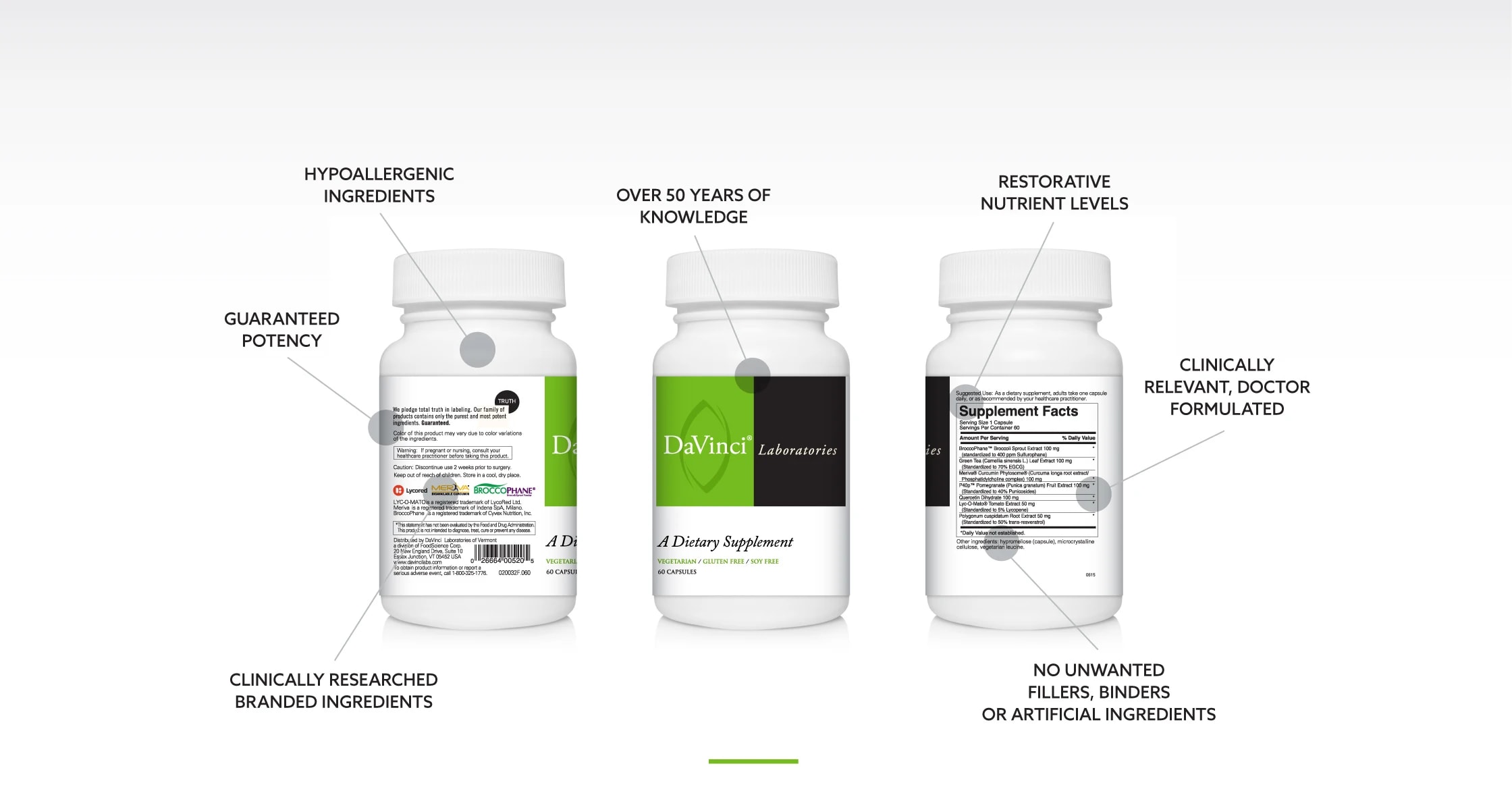
Every DaVinci Labs label carries what the company calls its Truth in Labeling pledge, and it goes further than most brands bother to. If a capsule's coating includes an ingredient, that ingredient appears on the label instead of getting folded into a generic line like "coating." If a soft gel needs water to hold its two halves together, the water gets listed too, right alongside every active ingredient. Adena said the questions this generates are common. People ask why something shows up on a DaVinci Labs label that they've never seen on a competitor's, and the answer is usually that the competitor decided a minor ingredient didn't need to be claimed. DaVinci Labs claims all of it.
The same standard shapes what goes into a formula in the first place. Instead of a generic filler, the team looks for an inactive ingredient that can also do something useful. Capsules are lubricated with vegetarian leucine instead of magnesium stearate. When a filler is needed, the team reaches for microcrystalline cellulose, a hypoallergenic plant fiber, rather than a cheaper bulking agent.
Nothing goes into a formula just to take up space on a label. If it's in the bottle, the team wants it listed, and they want it doing something.
Built to Last the Whole Shelf Life
Every dosage form goes through stability testing to confirm identity, purity, potency, and consistency from one capsule to the next, on a long-term basis rather than just an accelerated model, so a claim made at launch still holds at the end of the shelf life. Ingredient claims trace back to clinical trials, either on the ingredient at a clinical dose or on the finished product, and the team has a new trial starting within the month to confirm a claim the existing research already supports.
DaVinci Labs also built its own delivery technology, called Provail®, to solve a problem no supplier could answer for them. Glutathione, DIM, and CoQ10 are backed by research, but each shares a weakness: they're hard for the body to absorb and unstable in storage. Provail® is a patent-protected encapsulation method built in-house to keep those three molecules stable, because the market didn't have an existing solution that met the bar. It's an old habit at this point: DaVinci Labs sits inside the Food Science Corporation and once had its own biochemist invent a process to produce DMG with nothing else added, so the product could stay on shelves.
Pedro's answer to what he'd want a customer to know came from his own shopping list: he wants a company that formulated a product for an outcome, not to fill a label panel. The right ingredient, in the right form, at a dose that can do the job, with confidence that the amount on the label is still the amount in the capsule on the last day of its shelf life.
Adena's answer built on his. "It's not window dressing," she said. "They're clinical doses." A dose that matches what the research tested, not a token amount added so an ingredient can appear on the front of a bottle.
Speaking of Adena… She has spent 25 years, literally half her life, in the same role at the same company, and that kind of tenure tells you something about the quality of where she works. People don't stay that long, and stay that sharp and engaged, at a place that doesn't deserve it. Talking with her gave me a lot of confidence in DaVinci Labs, and it's a big part of why I walked away understanding the incredible ethos behind this brand.
DaVinci Labs, welcome to the TESTED by SuppCo family.