
Science Corner 56 | Beef Organs: Nature's Multivitamin or TikTok Wishful Thinking?

Organ meats are trending again, this time in capsule form. TikTok is full of testimonials about beef liver "fixing" energy, brain fog, and hormones. The supplements are everywhere, and the theory behind them sounds compelling. The problem is that "sounds compelling" is doing a lot of heavy lifting here.
Organ meats are among the most nutrient-dense foods on the planet. That doesn't mean buying them in a pill solves your health problems.
The theory is actually interesting
The case for beef organs as a supplement starts with real nutritional science. Organ meats, especially liver, are genuinely among the most micronutrient-rich foods humans eat. These aren't fringe claims. Organ meats were staples of traditional diets across virtually every culture before modern food processing stripped them from the Western table. The logic behind bringing them back, even in capsule form, is at least coherent.
Each organ brings something meaningfully different to the table:
Liver is exceptionally high in vitamin B12, vitamin A, copper, riboflavin, and choline. A 3-ounce serving provides several times the daily value of B12 alone.
Heart is one of the richest dietary sources of CoQ10, a compound involved in cellular energy production that most people rarely think about getting from food.
Spleen contains some of the highest concentrations of heme iron of any food, the form of iron the body absorbs most efficiently.
Where the theory gets stretched
Here's where the marketing tends to outrun the science.
Supplement companies have long leaned into what's called the "like supports like" principle: eat heart to support your heart, liver to support your liver, kidney to support your kidney. This idea has deep roots in folk medicine across cultures. It's also not established by clinical evidence. The notion that peptides or proteins from a bovine organ will selectively concentrate in your corresponding human organ isn't something we can confirm from the current literature.
More broadly, there are limited high-quality clinical trials directly evaluating beef organ supplements in humans, which means that most of the proposed benefits are inferred, not proven in supplement form. The claims typically rest on one of three things: the known nutrient profile of fresh organ meats, animal studies, or testimonials. None of those is a clinical trial.
What does the research actually say?
Honest answer: not much, and almost none of it applies directly to the supplement form.
The existing studies on beef liver look at whole food consumption, not freeze-dried capsules. Processing matters. Most organ supplements are made by dehydrating raw organs, milling them into powder, and encapsulating the result. A typical dose of 3 to 6 capsules a day works out to roughly 1 to 3 grams of dried powder. That's a small fraction of what you'd get from eating actual liver, and heat-sensitive compounds like certain B vitamins are particularly vulnerable to losses during processing. Freeze-drying preserves more than heat drying, but neither method perfectly replicates fresh organ meat.
What about the nutrients that do survive? They're real. Heme iron from organs is genuinely more bioavailable than non-heme iron from plants, and iron deficiency remains the most common nutritional deficiency worldwide. Vitamin B12, choline, copper, and CoQ10 are all well-studied and biologically meaningful. So if someone is deficient in any of these, there's a plausible argument for organ-based supplementation. But "plausible argument for filling a specific deficiency" is very different from "superfood that supports energy, hormones, immunity, and performance," which is what most labels promise.
The labeling problem is real
This is where I want to be direct, because it matters for anyone making purchase decisions.
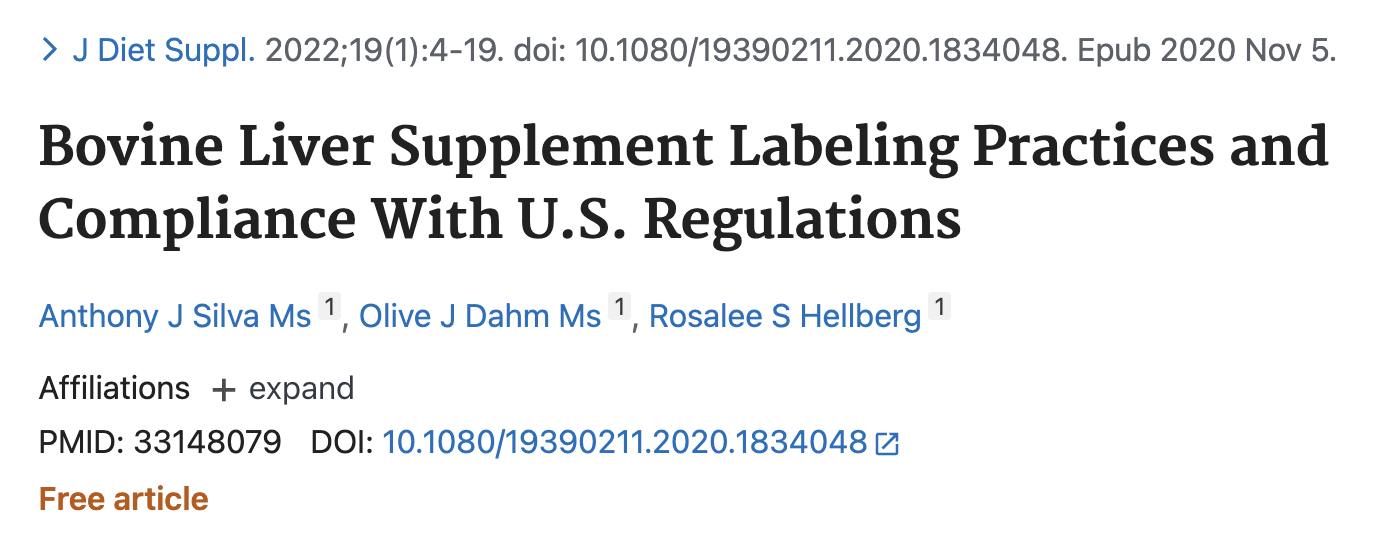
A study published in the Journal of Dietary Supplements examined 49 commercially sold beef liver supplements and found that 59% had at least one instance of noncompliance with U.S. labeling regulations. The majority, 85%, of the nutrient content on product labels was noncompliant. That's not a rounding error. If you're buying a supplement partly because of the nutrients listed on the label, those numbers may not reflect what's actually in the product.
This is a structural problem with the category, not a criticism of any single brand.
A note on vitamin A
One legitimate safety consideration: beef liver is extremely high in preformed vitamin A (retinol). Fat-soluble vitamins accumulate in the body. High concentrations of retinol in concentrated supplement form mean that daily use can push intake past safe levels, with potential consequences including liver damage, bone loss, and birth defects in pregnancy. If you're already taking a multivitamin or eating fortified foods regularly, the math can add up quickly. This isn't a reason to avoid organ supplements categorically, but it's a reason to pay attention to total vitamin A from all sources combined.
Where does this leave you?
The trend isn't wrong to point at organ meats as nutrition worth paying attention to. The evidence just doesn't support the broadest claims being made. Here's a reasonable framework:
If you have a documented deficiency in iron, B12, or copper, a well-sourced organ supplement from a brand with third-party testing is a defensible option worth discussing with your provider.
If you're looking for general optimization, the case is much weaker. A targeted, evidence-based supplement for whatever you're actually deficient in will almost certainly serve you better than a broad organ blend with unverified label claims.
If you're pregnant or taking medications, the vitamin A concentration in liver-based supplements warrants a specific conversation with your doctor before you start.
--
Personal note from Jordan
When I first saw beef organ supplements blowing up on TikTok, my reaction wasn't skepticism. It was curiosity. The nutritional case for organ meats is real, and the idea that we've quietly engineered them out of the Western diet while our health has gotten worse is worth taking seriously.
But there's a meaningful difference between "organ meats are nutrient dense" and "this capsule will fix your energy, hormones, and brain fog." The first is well established. The second is a marketing claim that clinical science hasn't caught up to yet.
What pushed me over the edge was the labeling data. When 85% of nutrient content claims across 49 products come back noncompliant, that's not a few bad actors. That's a category-wide problem. The trend is pointing at something real. But pointing at something real isn't the same as proving it works in pill form. Be curious, be open, and be willing to update when the evidence improves. Just don't let a TikTok algorithm make decisions about what goes in your body before the science has weighed in.