
Science Corner XX | A Landmark Study Just Connected Vitamin D to Alzheimer's Disease. Here's What It Means.

Most of us think about Alzheimer's prevention the way we think about retirement savings. Something to take seriously someday, just not yet.
A new study suggests that someday might already be here, happening in your 30s and 40s, whether you are paying attention or not.
Over 300,400 people have Vitamin D in their stacks on SuppCo. This study suggests that’s a great start.
The Study You Need to Know About
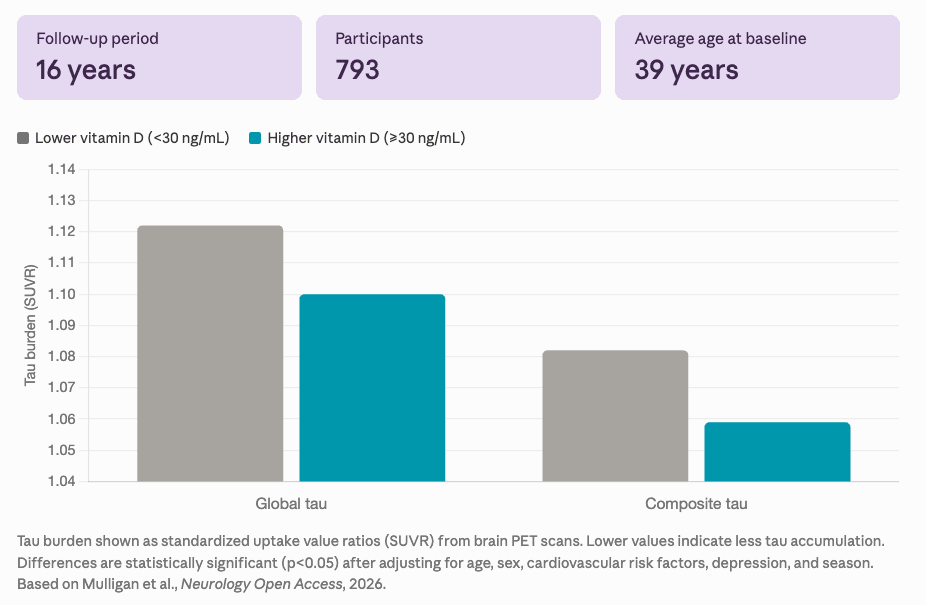
Researchers from the Framingham Heart Study followed 793 adults who had no signs of dementia. At the start of the study, the average participant was 39 years old. Researchers measured their vitamin D levels. Then, about 16 years later, they scanned each person's brain using a technology called PET imaging.
PET scans can detect early warning signs of Alzheimer's disease in the brain, years before any symptoms appear.
The result: people who had higher vitamin D in their late 30s had significantly less of a harmful protein in their brains 16 years later.
Not better memory scores. Not lower dementia rates. Less of the actual protein that drives Alzheimer's disease, measured directly in living brains.
That is a different kind of finding.
What Tau Is and Why It Matters
The harmful protein is called tau.
Tau is a protein that normally helps keep brain cells healthy and structurally sound. In Alzheimer's disease, tau goes wrong. It clumps together inside neurons and forms tangles. Those tangles spread from region to region across the brain, and that spreading causes the memory loss and cognitive decline we associate with Alzheimer's.
Here is the important part: tau starts building up in the brain long before any symptoms appear. You can have meaningful changes happening for years, even decades, without knowing it.
The researchers found that higher vitamin D at age 39 was linked to lower tau specifically in the regions of the brain that Alzheimer's hits first. These are the areas responsible for memory formation and recognition.
The study also looked at amyloid, another harmful protein involved in Alzheimer's. Vitamin D levels had no relationship with amyloid at all. The researchers believe this is actually consistent with how the disease progresses: tau shows up earlier in younger brains, so it makes sense that a younger cohort would show tau differences first.
What the Biology Suggests
This study cannot prove that vitamin D prevents tau buildup. It shows an association. But there is a reasonable biological explanation for why the relationship might be real.
Vitamin D receptors are found throughout the brain, including in areas tied to memory. Research in animals suggests that low vitamin D activates two enzymes that drive harmful changes to tau. Low vitamin D is also linked to more inflammation in the brain and more oxidative stress, both of which accelerate tau damage.
None of this has been fully proven in human clinical trials. But it is a plausible explanation, and the Framingham data adds meaningful human evidence to the story.
What the Findings Actually Show (and Don't)

A few important limits before we go further:
This is an association, not a cause. The study cannot tell us that taking vitamin D will lower tau. It shows that people who had higher vitamin D in midlife had lower tau 16 years later. That is meaningful, but it is not proof of cause and effect.
Vitamin D was only measured once. We do not know how levels changed over the 16 years between the first measurement and the brain scans. That limits what we can conclude.
The effect is real but modest. The association held up after adjusting for age, sex, heart disease risk factors, depression, and season. But the differences in tau levels were not enormous. This is a signal, not a silver bullet.
Most participants were white. We cannot assume these findings apply equally across all populations.
These are real limitations. They are not reasons to ignore the study. A 16-year follow-up, direct brain imaging, and a plausible biological mechanism is a serious body of evidence.
Higher vitamin D at 39 was linked to less tau in the brain at 55. That window is open right now for many people reading this.
What to Do With This
This is not an argument for taking large doses of vitamin D. It is an argument for paying attention.
Get your levels checked. Vitamin D deficiency is extremely common. In this study, about one-third of participants had levels below 30 ng/mL, a level many clinicians consider inadequate. A simple blood test tells you where you stand.
Understand what adequate looks like. Most clinical guidelines point to 30 ng/mL as a minimum floor, with 40 to 60 ng/mL as a reasonable target for healthy adults. The Framingham data suggest the benefit was spread across the full range, not just at the extremes.
Your situation is individual. Vitamin D levels are affected by sun exposure, skin tone, diet, body weight, and the time of year. Supplementation can help, but it is not a replacement for knowing your own baseline.
Keep the finding in perspective. Today, Alzheimer's disease has no cure. Lower tau on a brain scan is a promising early signal, not a guarantee of anything. Cautious optimism is the right response here.
The bigger picture: meaningful prevention may start earlier than we thought, and some of the tools involved are not complicated or expensive. That is worth taking seriously.
--
Personal note from Jordan
I spent eight years as Chief Scientist at an Alzheimer's company. We talked about drugs almost exclusively. That was not negligence. It was the nature of the field. Drug development is where the scientific prestige lives, where the funding flows, where the breakthroughs are supposed to come from.
What I did not think enough about, and what I have spent time reconsidering since, is how little attention we paid to what people could do before the disease was in the room. The conversations about prevention were always downstream of the conversations about treatment. And the interventions we considered were almost always pharmaceutical.
This study does not change the calculus on its own. But it represents something I find genuinely exciting: evidence that a simple, accessible, inexpensive intervention may be doing something real at the molecular level, in the decades before Alzheimer's would ever be diagnosed. My son is almost 2. I think about what his generation's understanding of prevention will look like compared to ours. I hope it looks a lot more like this.
We are not going to supplement our way out of Alzheimer's disease. But if we can identify the interventions that shift the biology early, before the damage compounds, we may change what that disease looks like for a lot of people. For me, it truly provides hope.